

What does the research say about in-ear latency and how should you as a sound engineer think?
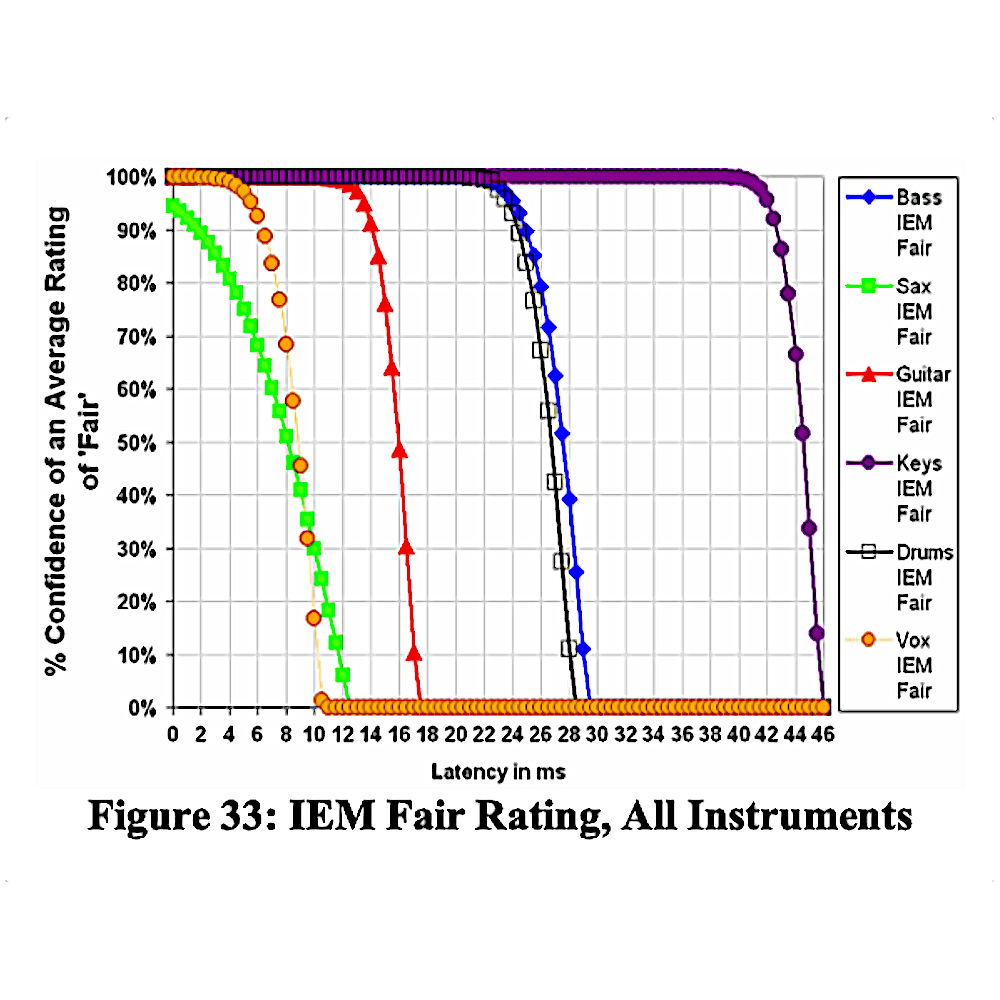
Summary: Singers with in-ear rarely experience problems with latency up to 4ms, after that it drops rapidly and at 8ms 50% experience difficulty singing. In contrast, keyboardists can handle a latency up to almost 40ms without experiencing problems.
Contact us if you need help!
- Fast Deliveries!
- Any Questions? We will help you!
- Multiple payment options!
- BrandAES
- SubjectLATENCY
Description
Here's how latency affects in-ear musicians (and why your instrument matters more than you think)
In the world of live music, every millisecond counts. Digital audio equipment has revolutionized the way we produce and amplify sound, but it comes with a hidden challenge: latency. The slight delay between when a sound is created and when a musician hears it can deeply affect their performance. But what if we told you that your instrument could be the biggest factor in how much latency you can handle?
A study from Purdue University and Shure delved into this very question, conducting listening tests with professional musicians on different instruments and with different latency settings. And the results are probably not quite what you think...
It's not you, it's your instrument
One of the most striking findings is that a musician's sensitivity to latency depends primarily on the instrument they play, not their individual listening skills. This means that a keyboardist can tolerate significantly more latency than a singer, even if both are highly trained professionals. For example, keyboardists consistently showed the highest tolerance for latency, probably because they are used to synth sounds with built-in delays. Singers, on the other hand, proved to be very sensitive, especially with in-ear monitors.
In-Ear Monitors (IEMs) require more precision
If you use in-ear monitors (IEMs), listen carefully: the study found that IEMs generally require much lower latency to achieve the same perceived quality compared to traditional stage monitors (wedges). This is because IEMs eliminate the natural acoustic delay you get from a speaker on stage, making digital latency artifacts more noticeable.
Interestingly, for some musicians using IEMs, a small amount of latency (around 1.4 ms) was actually preferable to no latency at all. This suggests that a small, controlled delay can mimic the natural acoustic environment and improve comfort. The study also found that playing with a non-delayed metronome (simulating a tape) could make some latency preferable to none, which is consistent with research suggesting an optimal delay for ensemble synchronization.
"General sensitivity": How consistent is your instrument's perception?
To further understand these differences, the researchers developed a measure for "General Sensitivity". This tells us how likely an instrumentalist's perception of latency is to change based on different monitor conditions or subjective criteria.
- Low General Sensitivity: Instruments like drums and keyboards have low general sensitivity. This means that their acceptable latency limits are fairly stable and predictable, whether they use IEMs or wedges, or whether they focus on subtle artifacts such as comb filters versus obvious delays.
- High Overall Sensitivity: Singers and saxophonists showed high overall sensitivity. For these instruments, acceptable latency is more fluid and context-dependent, making it harder to define a single, universal limit.
What does this mean for you as a musician and sound engineer?
Instead of a one-size-fits-all solution, the future of professional audio system design needs to be instrument-aware and context-sensitive.
- For system designers: You need to understand the needs of each user and then optimize the latency chain for each musician and singer. It also means knowing how each part of the signal chain performs, and piecing together an optimal chain for each given moment.
- For sound engineers: Understanding these nuances allows for more informed decisions when selecting a monitor system, ensuring that each musician gets the precise, low-latency monitoring they need to perform at their peak.
Ultimately, by recognizing the unique ways that different instruments and monitor settings interact with latency, we can create more enjoyable live performances for everyone on stage.
If you would like to read the full report, it is attached below.
Need help understanding or translating this into practice, or want help with product selection for a production or installation? Contact us and we will help you!
Product specialist: Anders Brandén
Mail: anders@visono.se
Phone: 076-634 51 68
Files and media
 | AES Convention paper |