

TEST: Which directional speaker is right for you?
- Fast Deliveries!
- Any Questions? We will help you!
- Multiple payment options!
- BrandAKOUSTIC ARTS
- SubjectRIKTADE HÖGTALARE
Description
Technical specifications in brief
| Manufacturer | Model of the vehicle | Technology | Dimensions (cm) | Sound level at 1 kHz @1m (dBA) | Listening zone at -6 dB @1m (cm) |
|---|---|---|---|---|---|
| Acoustic Arts | B | Ultrasonic | 26 x 26 x 3.2 | 82 | 20 |
| Holosonics | Audiospotlight AS-16iX | Ultrasonic | 40 x 40 x 4,2 | 84 | 35 |
| Ultrasonic Audio Technologies | Acouspade Classic | Ultrasonic | Ø27 x 1,9 | 84 | 26 |
| Waves System | HSS3000 | Ultrasonic | 30,5 x 15,2 x 5 | 82 | 31 |
| Panphonics | Compact | Planar waves | 60 x 60 x 1.4 | 95 | 50 |
| Manufacturer | Model of model | Mounting | Operating conditions | Analog input | Digital input/output |
|---|---|---|---|---|---|
| Acoustic Arts | B | VESA FDMI MIS-D 100x100mm - M4X10 mountings | Indoor only, 0-40°C, 10-70% non-condensing | 3.5mm TRS mini-jack stereo 1.4V RMS, 60KΩ Balanced 4V RMS, 40KΩ | TOSLINK optical connectors S/PDIF LPCM 32-96 kHz |
| Holosonics | Audiospotlight AS-16iX | VESA100 | - | 3.5 mm stereo audio input; Phoenix balanced audio 24 VDC | none |
| Ultrasonic Audio Technologies | Acouspade Classic | Customized | -20-60°C, 0-95% non-condensing | RCA (Cinch) Stereo audio | None |
| Waves System | HSS3000 | Adapted | Indoor only, 10-40°C, 0-95% non-condensing | RCA (Cinch) Stereo audio (on external amplifier) | None |
| Panphonics | Compact | VESA100/200/400 | Indoor only, -10-70°C | RCA (Cinch) Stereo audio (on external amplifier) | None (on external amplifier) |
Analysis of dispersion angle and source-to-head distance
When comparing directional speakers, understanding dispersion angle and source-to-head distance is critical to assessing how well each speaker can direct sound to a specific area.
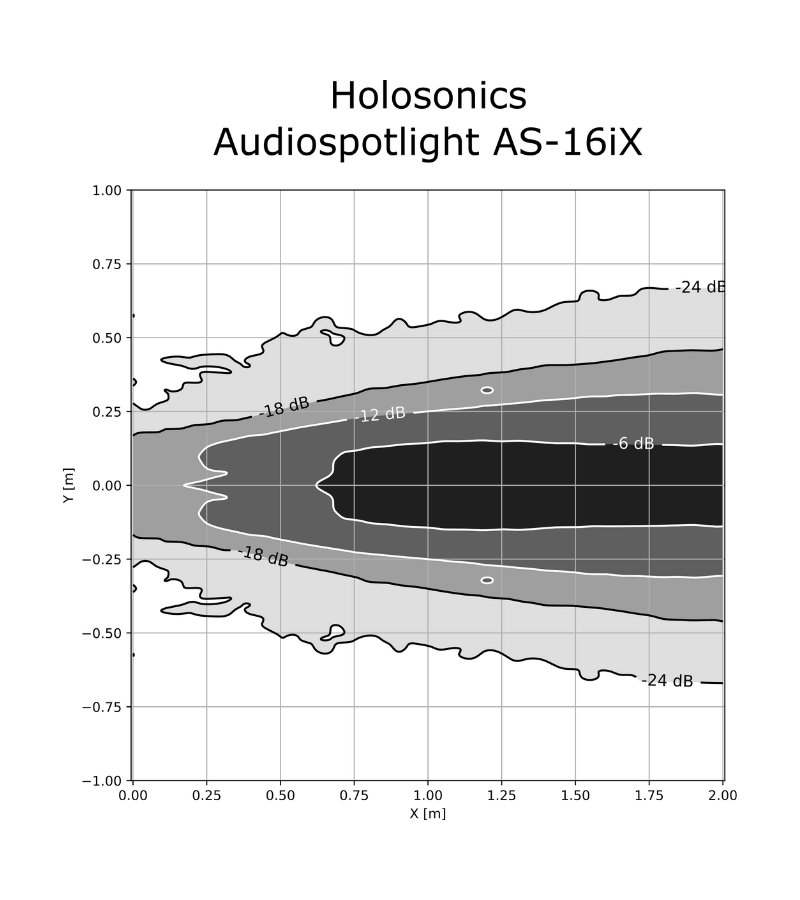
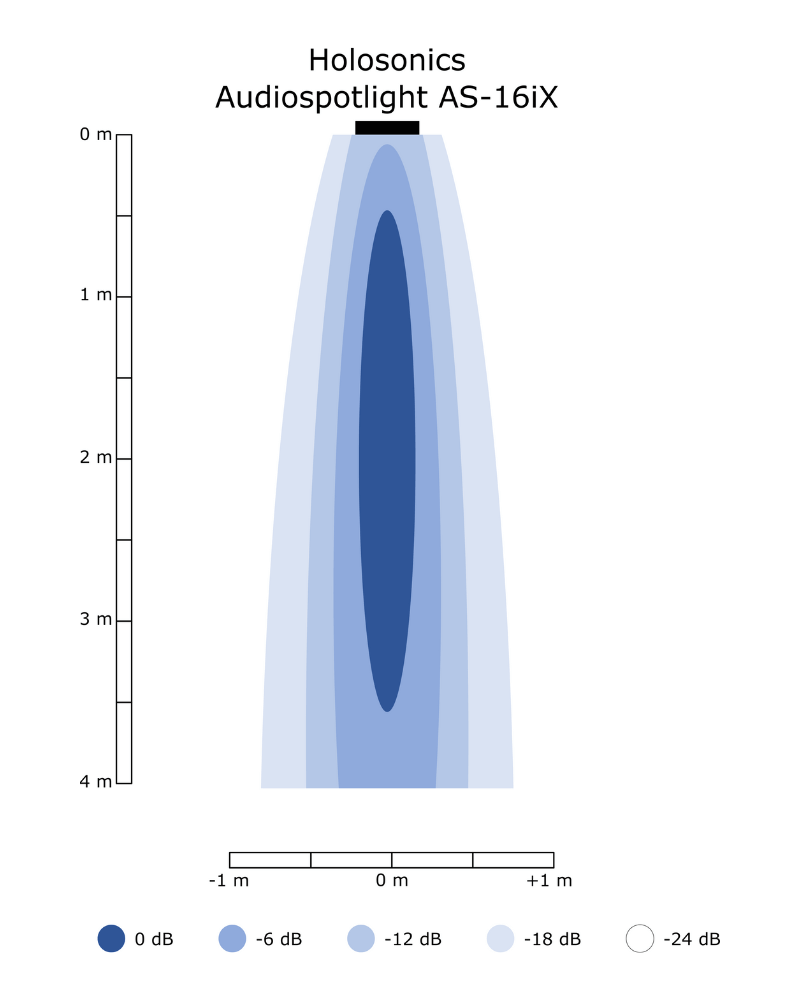
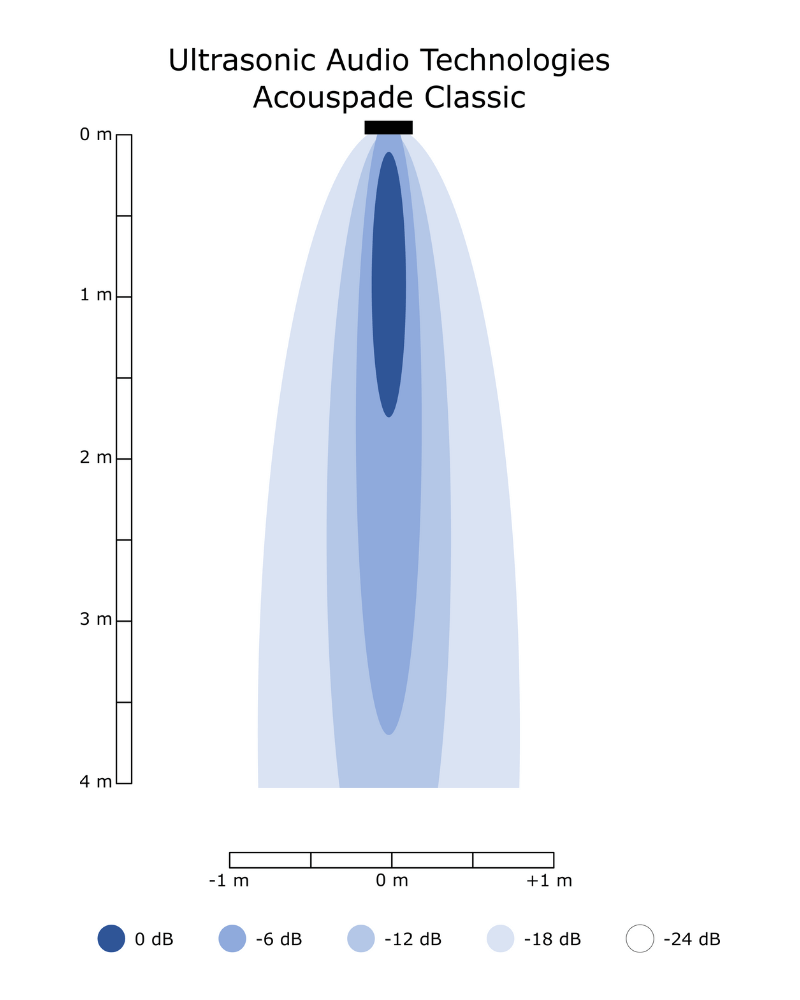
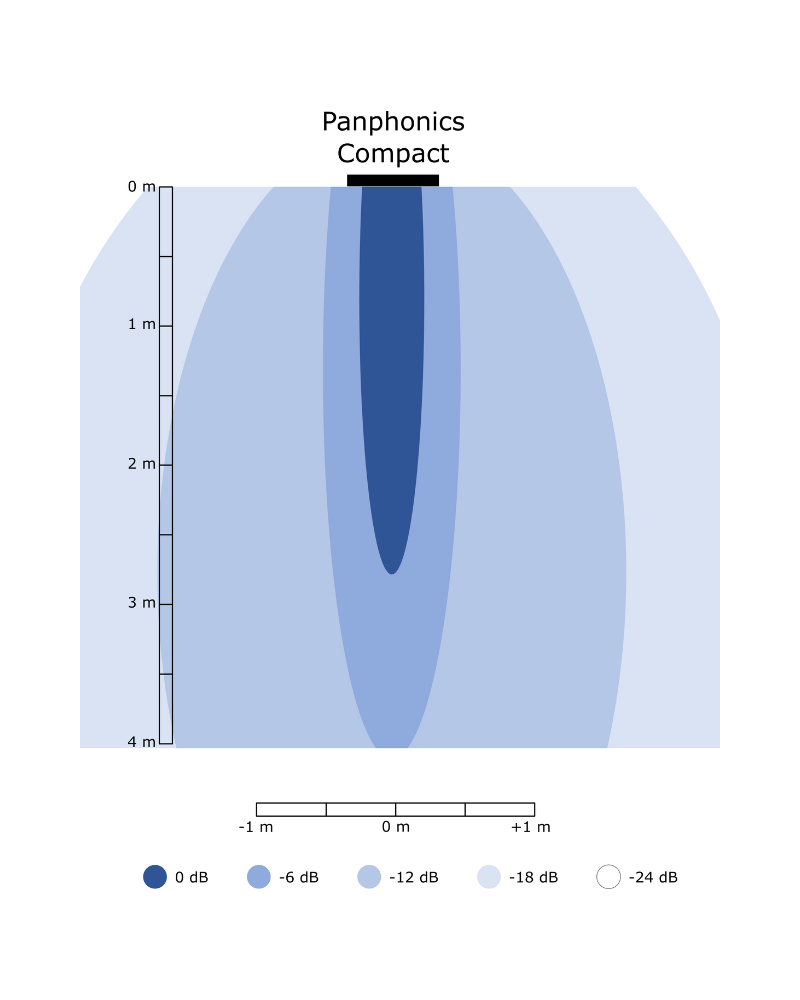
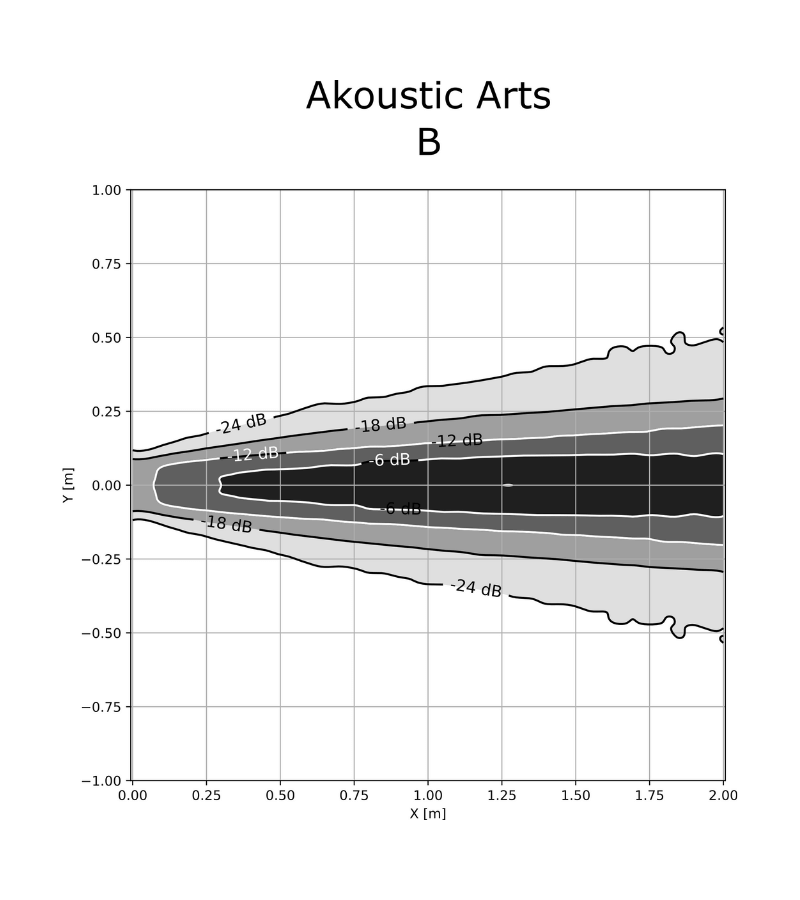
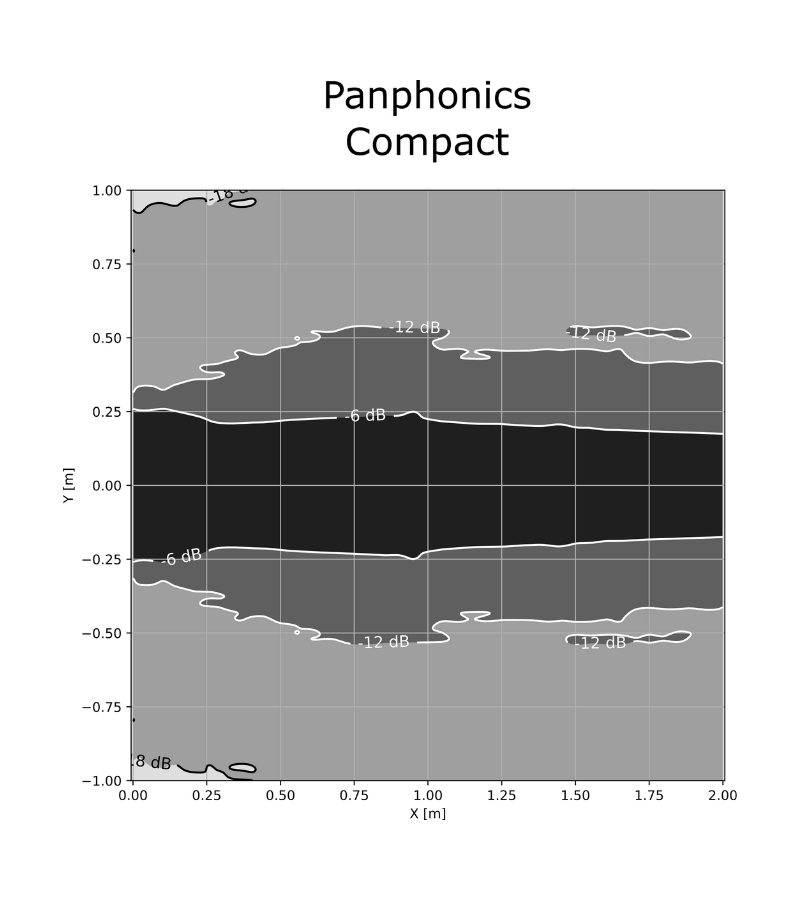
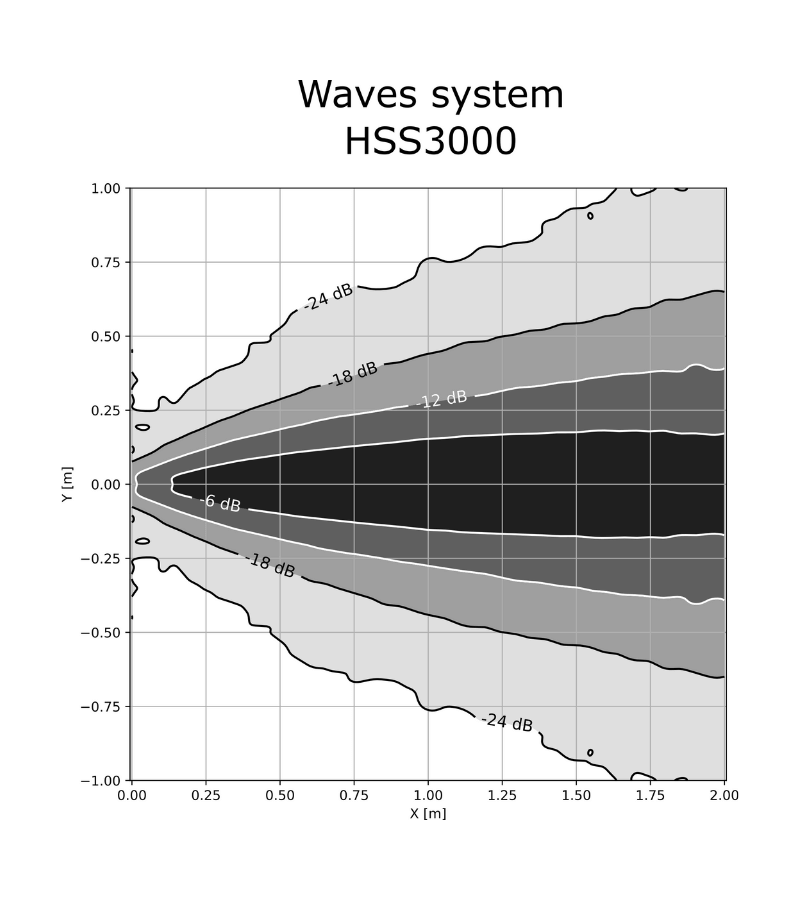
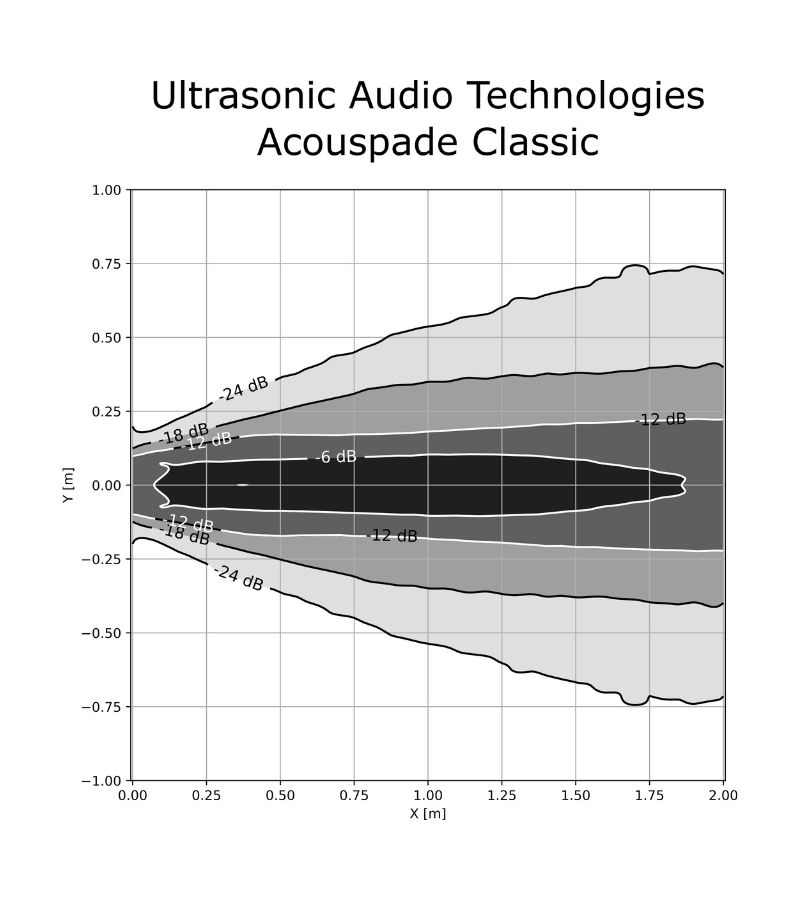
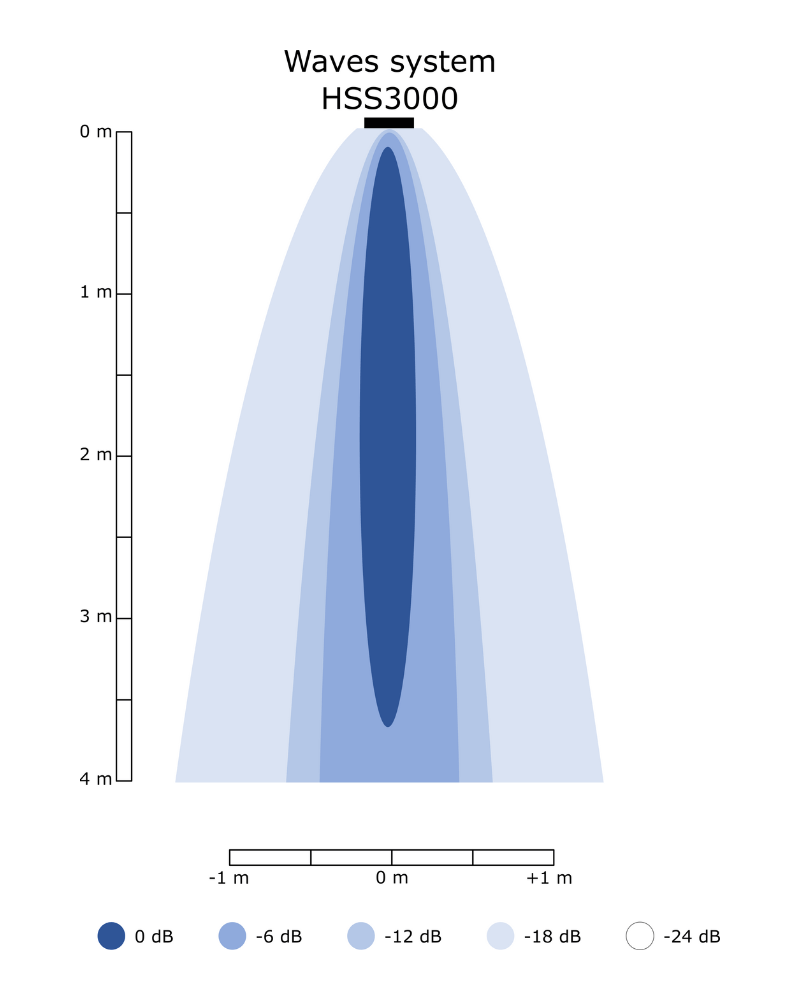
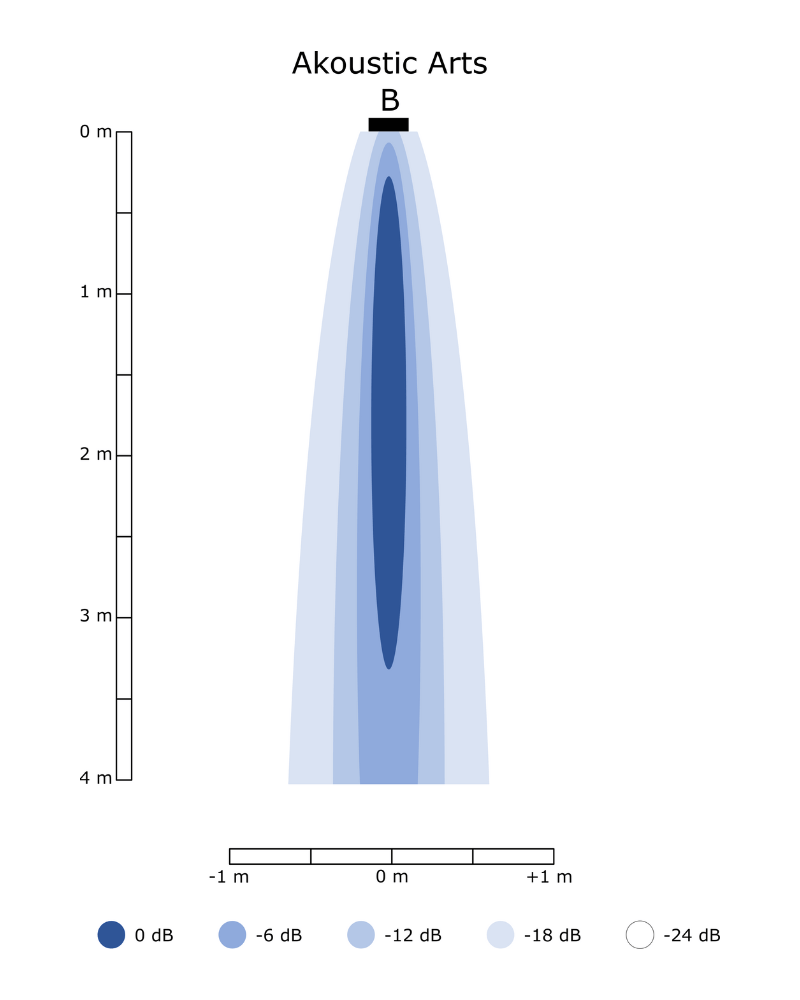
Beam angle indicates the width of the sound beam as it travels from the speaker to the listener, measured at different distances and sound levels. A narrower beam angle ensures that sound is concentrated in a specific area, reducing sound leakage to unwanted zones - important in environments such as museums, retail and corporate spaces where precision is crucial.
Source-to-head distance describes how far away from the speaker the listener can be and still perceive optimal sound. A speaker that maintains a narrow dispersion angle over longer distances is ideal for environments where the listener's position can vary or where precise sound delivery is required in larger spaces.
| Distance between source and head | 1m @-6dB | 2m @-6dB | 1m @-12dB | 2m @-12dB | 1m @-24dB | 2m @-24dB |
|---|---|---|---|---|---|---|
| B | 0.2 m | 0.2 m | 0.3 m | 0.42 m | 0.65 m | 1 m |
| Audiospotlight AS-16iX | 0.35 m | 0.35 m | 0.55 m | 0.60 m | 1.1 m | 1.3 m |
| Acouspade Classic | 0.2 m | X | 0.36 m | 0.45 m | 1.1 m | 1.5 m |
| HSS3000 | 0.31 m | 0.35 m | 0.55 m | 0.80 m | 1.5 m | >2 m |
| Compact | 0.5 m | 0.5 m | 1.05 m | 1 m | >2m | >2m |
Frequency response
Frequency response is a critical factor in assessing sound quality, especially for directional speakers. A broad and even frequency response ensures that sound is reproduced accurately across the entire frequency range, from the lowest bass notes to the highest treble notes.
In directional speakers, analyzing the frequency response reveals how well the sound quality is maintained within the directional sound beam. An uneven response can lead to exaggerated or attenuated frequencies, which degrades the sound experience.
Harmonic Distortion
When comparing directional loudspeakers, the degree of harmonic distortion is an important measure of sound quality. Harmonic distortion occurs when a loudspeaker introduces additional, unwanted frequencies into the audio signal, which can result in a muddy or harsh sound. A low level of harmonic distortion indicates that the speaker faithfully reproduces the original sound without adding these unwanted artifacts.
For directional speakers, maintaining a low level of harmonic distortion is particularly important, as they are often used in environments where sound clarity is crucial, such as in exhibitions, galleries or targeted advertising. High distortion can interfere with the listening experience, make speech difficult to understand or make music sound unnatural. By analyzing the harmonic distortion levels of different speakers, you can determine which model delivers the cleanest and most accurate sound, so that your audience hears the sound as it was intended, without distortion or loss of quality. The image below shows measurements of a logarithmic chirp at 1 meter distance and the manufacturer's nominal input level.
Directionality / Sound beams
Directionality of directional loudspeakers refers to the ability of the loudspeaker to focus sound in a specific direction and minimize sound leakage to nearby areas. This property is crucial for applications where precise sound directionality is necessary, such as in exhibitions, retail environments or interactive displays.
By analyzing the directivity of a speaker, it is possible to assess how well the sound beam can be confined to the intended area. This ensures that only the target audience hears the sound clearly, without disturbing people nearby.


Directionality per Third Octave Band
Directionality per third octave band goes one step further by breaking down the speaker's performance across different frequency ranges. This analysis provides a detailed picture of how consistently the speaker directs sound at low, mid and high frequencies.
A loudspeaker that maintains consistent directivity across all one-third octave bands ensures uniform sound coverage and clarity throughout its frequency range. This is particularly important in environments where both speech and music must be delivered with precision and clarity.
By comparing directivity and performance per third octave band, you can determine which speaker offers the most focused and balanced audio experience. This ensures that the sound is directed correctly and spread evenly across the frequency range.


Damping field
The damping field describes how the sound intensity decreases as the listener moves away from the speaker. This is crucial for understanding how directional sound works in environments such as museums, exhibitions or retail spaces.
This concept is closely linked to the distance between the sound source and the listener's head, where the sound level decreases the further away from the speaker the listener is. By understanding the damping field, one can assess how well a loudspeaker maintains clear, directional sound over distance while minimizing sound leakage to surrounding areas.
This control over sound dispersion ensures that sound is delivered accurately to the intended audience without disturbing others nearby.


Test methodology
Our test methodology has been developed by our R&D team under the guidance of researchers with PhDs in acoustics. The same methodology and test conditions have been applied consistently to all products.
Test protocol
- All speakers were tested in a controlled acoustic environment to eliminate external interference.
- We used advanced measurement equipment, including calibrated ECM microphones and a 3D measurement robot.
Measurement types
- Sound level at 1 kHz: Measurement of sound pressure level (SPL) at 1 meter distance with a 1 kHz sine wave.
- Frequency response: Test with a sweep signal from 20 Hz to 20 kHz to assess the accuracy of sound reproduction.
- Directionality: Analysis of sound focusing in different directions and angles.
- 2D sound field analysis: Mapping of sound dispersion in front of each speaker using a 3D measurement robot.
For more technical details, please visit: https://www.akoustic-arts.com/