
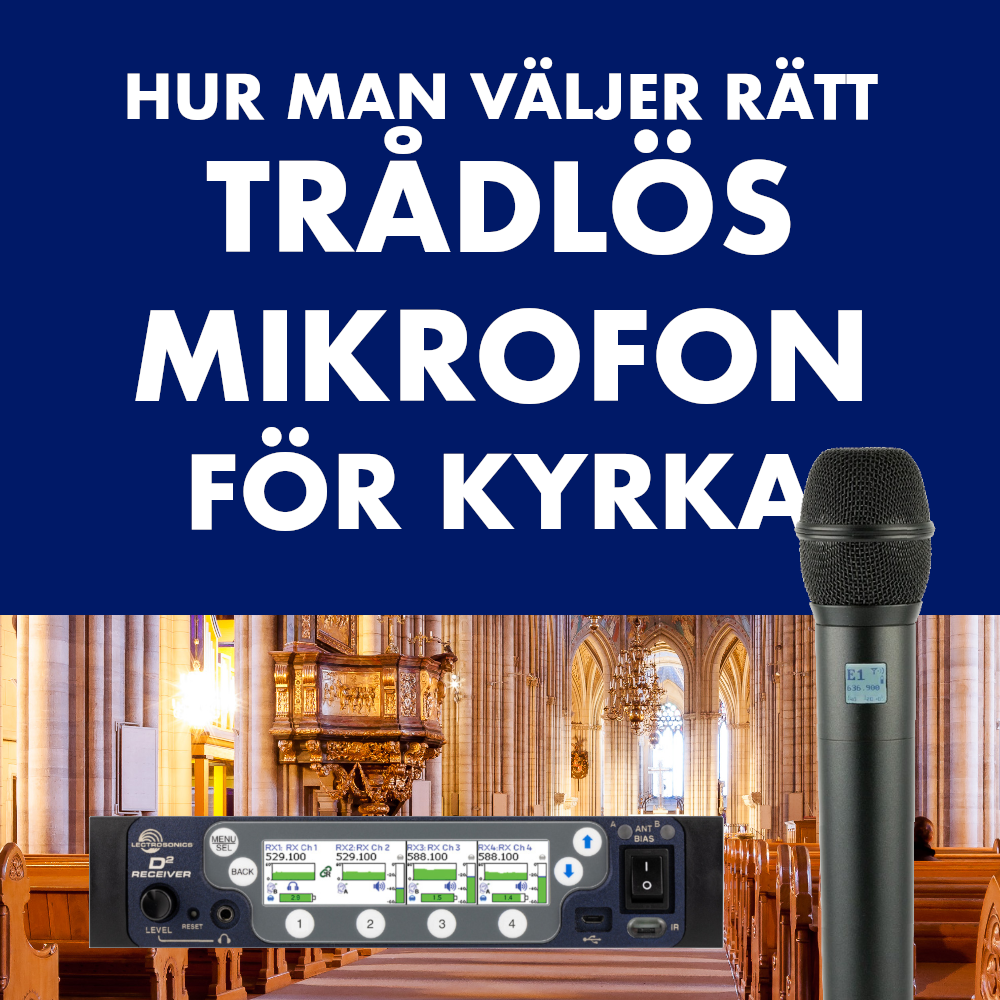
How to choose the right wireless microphone for church
- Fast Deliveries!
- Any Questions? We will help you!
- Multiple payment options!
- BrandLECTROSONICS
- SubjectTRÅDLÖST
Description
Introduction to sound equipment
Churches have specific requirements for sound equipment. It's not just about being heard - it's about being heard clearly, without noise, ringing or interruptions. Wireless microphones offer flexibility, but choosing the right system requires knowledge of both the technology and the acoustics of the venue.
1. What will the microphone be used for?
Think first about the intended use:
Preaching: do you want discreet lavalier microphones or headsets for free movement.
Choirs and music: handheld microphones and/or instrument transmitters are needed.
Dramatizations and events: multiple systems with good frequency coordination are needed.
2. Choose the right frequency range
In Sweden, it is important to use approved frequency bands for wireless systems. Avoid frequencies used by mobile and Wi-Fi networks (such as 2.4GHz and 5GHz) and go for systems that offer:
Narrowband technology - increased frequency security.
Automatic frequency scanning - minimizes interference.
Examples of authorized areas (2025):
470-694 MHz, with license from PTS (don't be scared, it's super easy to get)
823-832 MHz, license-free
863-865 MHz, license-free but sensitive to interference
3. Choose the right microphone type
Lavalier: small, unobtrusive - ideal for preachers but susceptible to feedback.
Headset: stable mount, clear sound - good for moving speakers.
Handheld: sturdy, flexible - good for singing and general use.
Consider: dynamic vs condenser - condenser microphones provide better detail reproduction but can be more sensitive to feedback.
4. Number of channels and scalability
Churches that have multiple microphones running at the same time need systems with good intermodulation handling and frequency coordination. Professional systems from e.g. Sennheiser, Lectrosonics or Sound Devices offer stable performance even with many simultaneous transmitters.
5 Practical features to look for
Long battery life / rechargeable batteries
Clear display and status monitoring
Robust construction
Product recommendations
Mid-range: Sennheiser EW-D ME2/835-S Combo Set
A digital system with both handheld and mosquito in the same package. Ideal for small and medium-sized churches.
See the product here
Premium: Lectrosonics D Squared Series with M2Ra and DBu
Extremely rugged system with excellent range, sound quality and frequency reliability. Ideal for larger congregations and critical applications.
Read more about Lectrosonics D Squared here
Need help choosing the right system? Contact us and we'll help you find a solution that fits your church.
Contact us for more information
Conclusion
A wireless microphone solution for churches should be reliable, easy to use and tailored to the needs of the venue. Invest in the right system from the start - it will provide both better sound and fewer technical concerns during services and events.
Ready to upgrade the sound in your church? Explore our range of wireless microphones adapted for churches and public spaces.