
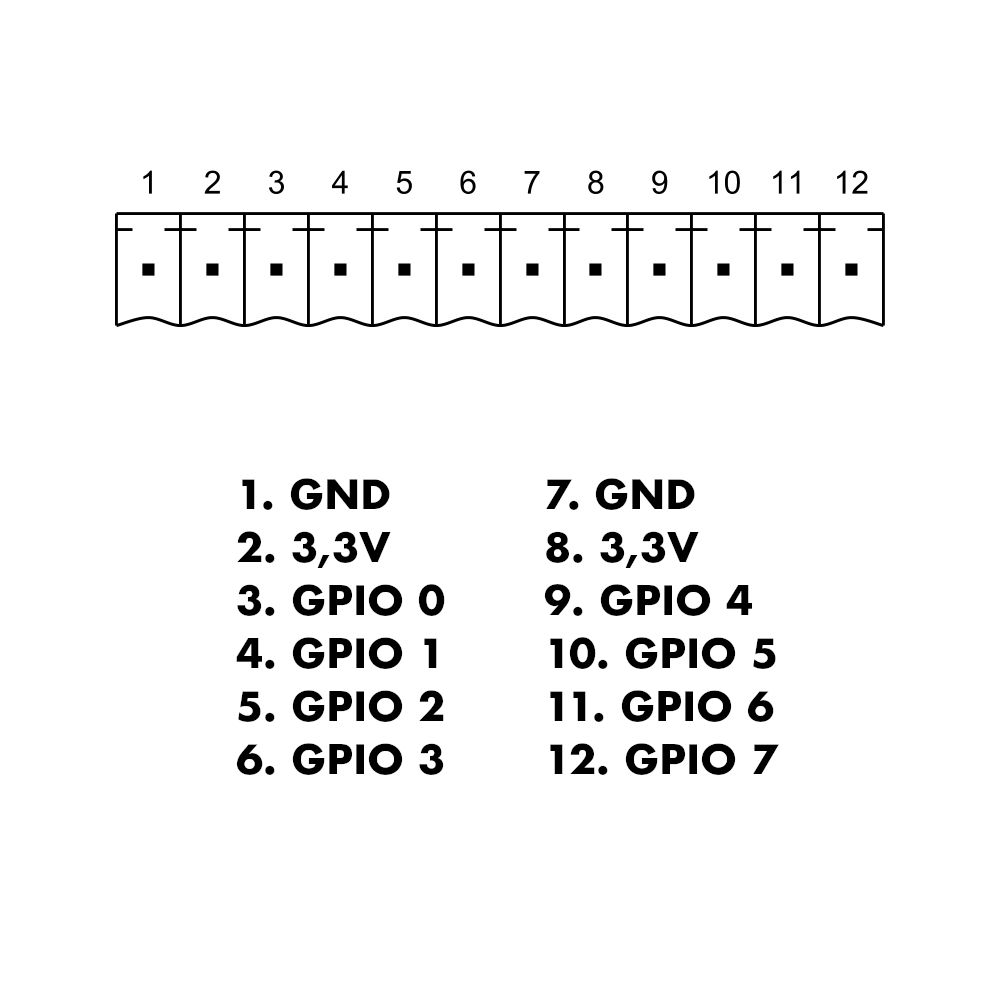
GPIO pinout for Brightsign players
1. GND
2. 3,3V
3. GPIO 0
4. GPIO 1
5. GPIO 2
6. GPIO 3
7. GND
8. 3,3V
9. GPIO 4
10. GPIO 5
11. GPIO 6
12. GPIO 7
- Fast Deliveries!
- Any Questions? We will help you!
- Multiple payment options!
- BrandBRIGHTSIGN
- SubjectDIGITAL SIGNAGE
Description
GPIO Block
The Brightsign players has a 12-pin Phoenix GPIO port with 8 bi-directional GPIOs.
The GPIO port is a standard design manufactured by Phoenix Contact, Wurth Electronics, and others. Pluggable GPIO terminal blocks can be inserted into the GPIO connector to make bare-wire contacts.
Connect the LED outputs to the LED ANODE and connect the LED CATHODE to the ground. If you want to connect another device, then the output is capable of sourcing or sinking up to 3.3V at 24mA, but there is a series resistor of 100Ω in each line.
The GPIO also allows for connecting of external contact closures to the ground. In order to connect a switch, connect one side of the switch to the switch input, and connect the other side to one of the ground pins on the GPIO connector. The connector can also supply 3.3V at up to 500mA to an external device. The 3.3V output is polyfuse-protected and can source up to 500mA.
If one BrightSign player is driving the inputs on another BrightSign player, then you can drive at most three inputs from one output. The following calculations explain this limitation:
Notes
The GPIO outputs have 100Ω series resistors; the GPIO inputs have 1K pullup resistors to 3.3V; and the input threshold is 2V high and .8V low. The high voltage is not problematic, but the low voltage can be if there are too many inputs connected to one output.
1 out driving 1 in | V=3.3*100/(100+1,000)=0.3 |
1 out driving 2 in | V=3.3*100/(100+500)=0.55 |
1 out driving 3 in | V=3.3*100/(100+333.3)=0.76 |
1 out driving 4 in | V=3.3*100/(100+250)=.94 (This is too high, so 1 output driving 3 inputs is the maximum) |
The following table describes the pinout of the GPIO:
Pin | Function | Pin | Function |
|---|---|---|---|
1 | GND | 7 | GND |
2 | 3.3V | 8 | 3.3V |
3 | BUTTON 0 | 9 | BUTTON 4 |
4 | BUTTON 1 | 10 | BUTTON 5 |
5 | BUTTON 2 | 11 | BUTTON 6 |
6 | BUTTON 3 | 12 | BUTTON 7 |